esiBlog
Servo Drive: Precise Motion for Modern Machines
What Is a Servo Drive?
In modern production and special-purpose machinery, motion has to be fast, precise and reliable. Axes accelerate, position, synchronize and brake – often in short cycles and under changing loads.
This is exactly where servo drives come into play. They combine a precise servo motor with an electronic servo controller and a feedback system. This allows the drive to monitor its motion continuously and respond to deviations.
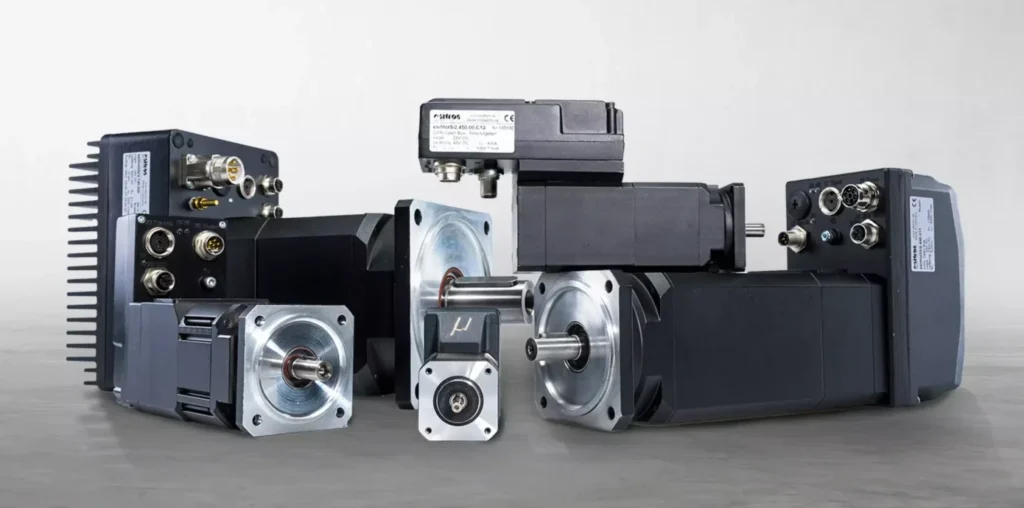
At esitron-electronic, we go one step further: with the esiMot compact drives, the servo motor and servo controller are integrated directly into one compact unit. The intelligence sits where the motion is generated – right at the motor.
A classic servo drive essentially consists of three components:
Servo motor: a dynamic, usually brushless permanent-magnet synchronous motor
Servo controller: the electronic unit for controlling and regulating the motor
Feedback: for example via encoder or resolver, to capture position and speed
These components work together as a closed control loop (closed loop).
The servo controller receives a setpoint, for example for position, speed or torque. At the same time, the feedback system continuously supplies information about the motor’s actual state. By comparing the setpoint with the actual value, the controller detects deviations and corrects the motor’s movement accordingly.
The result: high dynamics, precise positioning and reproducible motion sequences.
What Does Closed Loop Mean?
In simplified terms, the relationship can be expressed as follows:
Control deviation = setpoint – actual value
The servo controller tries to eliminate this control deviation as quickly and precisely as possible.
This is a decisive difference compared with simple open-loop drives. The servo drive not only “knows” what the motor is supposed to do – it also captures what the motor is actually doing.
Modern control methods enable a very fast response to load changes, acceleration events or position deviations.
How Does a Servo Drive Work?
The process can be described in three simplified steps:
1. The higher-level controller specifies the setpoint.
A PLC, a motion controller or another machine controller specifies, for example, position, speed or torque.
2. The servo controller compares setpoint and actual value.
The feedback system supplies the motor’s current values. The controller detects whether the actual motion deviates from the specified value.
3. The servo controller corrects the motor’s movement.
Voltage and current are adjusted accordingly. The motor follows the specified motion profile as exactly as possible.
This process repeats continuously. As a result, the servo drive can work precisely even during dynamic movements and under changing loads.
Servo Drive or Standard Drive?
Not every axis needs a servo drive. What matters is the respective application.
A simple standard drive can be entirely sufficient, for example, for a constant conveying motion. However, as soon as fast movements, exact positioning, synchronization or high repeatability are required, a servo drive offers clear advantages.
| Standard drive | Servo drive | |
|---|---|---|
| Control | open-loop or simpler closed-loop control, depending on design | closed control loop |
| Feedback | often not required | encoder/resolver |
| Dynamics | suitable for simple movements | very high |
| Positioning | limited, or additional components required | precise and repeatable |
| Response to load changes | limited | fast readjustment |
| Typical application | simple conveying and rotary movements | dynamic axes and positioning tasks |
The right drive technology always depends on the specific machine task. A high-performance servo drive is not automatically the best solution for every axis.
What Are the Advantages of a Servo Drive?
Servo drives are used above all when a machine has to perform movements dynamically, precisely and repeatably.
High dynamics
Servo motors can accelerate and decelerate quickly. This enables short cycle times and dynamic motion profiles.
Precise positioning
Thanks to the feedback system, the drive can capture its current position and correct deviations. This is crucial, for example, in feeding, positioning or pick-and-place applications.
High repeatability
Motion sequences can be executed reproducibly – even with frequent load changes and varying operating states.
Drive monitoring
Modern servo drives capture operating states and can, for example, provide information on position, speed, load or fault conditions. This simplifies diagnostics and commissioning.
Communication with the machine controller
Depending on the design, servo drives can be integrated into automation systems via various interfaces – for example PROFINET, EtherCAT, CANopen or Modbus.
Integrated Servo Drive: Servo Motor and Controller in One Unit
With classic servo drives, the motor and the servo controller are often physically separated. The controller sits in the control cabinet, while the motor is mounted on the respective machine axis.
For many machine concepts, however, a decentralized solution is the better fit.
In an integrated servo drive, the servo motor and servo controller are combined into one compact unit.
This is precisely the principle esitron follows with the esiMot compact drives.
esiMot: Intelligence Right at the Motor
The esiMot combines a servo motor and an integrated servo controller in one compact drive.
This distributes the drive technology across the machine: the drive sits where the motion is needed – the controller component does not necessarily have to be housed in the control cabinet.
This can bring advantages, especially for machines with many axes.
Fewer central components. Less wiring effort. More intelligence directly at the axis.
The decentralized architecture can reduce long motor cables and complex control cabinet wiring. Depending on the machine concept, it can also save valuable space in the control cabinet.
This makes integrated servo drives interesting for applications such as:
- Packaging machines
- Production and special-purpose machines
- Conveying and intralogistics systems
- Feeding systems
- Assembly lines
- Automation solutions with many decentralized axes
Why Decentralized Servo Drives and Compact Drives?
In a classic centralized architecture, many connections converge between the control cabinet and the motors. As the number of axes increases, so does the effort for cabling, installation and commissioning.
A decentralized drive architecture moves part of the drive technology directly into the machine.
With the esiMot, the motor and servo controller already sit in one unit. This opens up new possibilities for the machine layout:
The control cabinet no longer has to be the central location for every drive function.
This can mean:
- less wiring
- shorter cable runs
- less space required in the control cabinet
- simplified installation
- modular machine concepts
- decentralized arrangement of axes
- good scalability for machines with multiple drives
Especially in modular machines or long production lines, a decentralized solution can play out its advantages.
Where Are Servo Drives Used?
Servo drives are used wherever movements have to be executed quickly, precisely and reproducibly.
Packaging technology
In packaging machines, various movements must be precisely coordinated. These include, for example, feeding, positioning, cutting, forming or sealing.
Conveying technology and intralogistics
Servo drives enable precise movements and dynamic sequences in feeders, transfers and positioning tasks.
Production and special-purpose machines
In customized machine concepts, several axes often have to be coordinated with one another. Servo drives provide the required dynamics and control accuracy.
Assembly automation
In assembly processes, reproducible positions and defined motion sequences are often essential.
Printing and converting technology
Synchronized movements and precise speeds are decisive here for a stable production process.
Food and pharmaceutical technology
In hygienically demanding areas, drive solutions must meet requirements for cleaning, materials and degree of protection in addition to the technical requirements. Specially designed decentralized drive solutions are of interest here.
When Is an Integrated Servo Drive the Right Solution?
The question is not solely how powerful a drive is, but how it can best be integrated into the machine.
An integrated servo drive can be particularly interesting when:
- several decentralized axes are used,
- the control cabinet is to remain compact,
- wiring effort is to be reduced,
- short cable runs are desired,
- modular machine concepts are implemented,
- dynamic and precise movements are required,
- drive functions are needed directly at the machine.
The drive solution should always suit the application. Key factors include the required torque, speed, dynamics, positioning accuracy, environmental conditions, communication interfaces and safety requirements.
Servo Drive and Integrated Servo Drive: What Is the Difference?
The fundamental difference lies less in the actual control task than in the architecture of the drive.
A classic servo drive consists of a separate servo motor and a physically separated servo controller.
In an integrated servo drive, both functions are combined in one unit.
Classic:
Servo motor → motor cable → servo controller in the control cabinet
Decentralized with esiMot:
Servo motor + servo controller → directly at the machine axis
This turns a single motor into an intelligent, decentralized drive unit.
Conclusion: Servo Technology for Precise and Dynamic Machines
Servo drives are in demand whenever machine movements must be precise, fast and reproducible. The combination of servo motor, control and feedback enables continuous monitoring and correction of the motion.
With integrated servo drives such as the esiMot, a further aspect is added: the intelligence of the drive technology is brought directly to the axis.
This opens up additional possibilities for machine builders in terms of control cabinet, wiring, machine layout and modular automation concepts.
For esitron, decentralized drive technology therefore means more than just a motor with an integrated controller:
More intelligence at the motor. Less effort in the control cabinet. More possibilities for the machine.
Are you planning a new machine or would you like to decentralize an existing drive solution?
Then it is worth taking a look at the specific application. Which servo drive makes technical and economic sense always depends on the requirements of the respective axis.
esitron supports machine builders in selecting and sizing suitable drive solutions – from an individual servo controller to the integrated esiMot compact drive.