esiBlog
Practical Example: Synchronized Automatic Winding and Cutting
Why Precision Occurs in Film Webs Along the Axis
Why the precision of speed control is crucial to the quality of film webs
In systems that wind and cut film or packaging material, product quality depends directly on the precision of the drive control. Decentralized servomotors with integrated electronics, such as the esiMot series from esitron, enable precise speed control and tight synchronization between the winding and cutting units—something that can sometimes be a problem with traditional, centrally controlled drive solutions.
The problem: Tensile strength and cutting accuracy with web material
A common scenario in packaging technology:
A machine processes film webs that are simultaneously wound onto a roll and cut to defined lengths or widths. Two requirements come into play here that influence each other.
During winding, the tension must be kept constant, regardless of whether the roll is still empty or already nearly full. If the tension is too high, the film becomes too thin or tears. If it is too low, scrap is also produced. During cutting, it is crucial that the cutting unit operates precisely in sync with the passing web. If the winding shaft runs even slightly out of sync with the cutting unit, the cut edges shift—resulting directly in material loss and scrap.
Our solution: Decentralized drive control directly on the axis
With traditional, centrally controlled servo controllers, the speed or position signal must travel from the control cabinet to the axis via the signal line, be processed there, and the response must be fed back. When multiple axes are running in sync, these signal paths add up.
In the esiMot series, the power electronics are located directly on the motor. This shortens the control path between the setpoint and the actual speed adjustment on the axis itself. For a system with combined winding and cutting functions, this means that the winding axis and the cutting unit can be closely synchronized.
What fieldbus interfaces and safety functions are available?
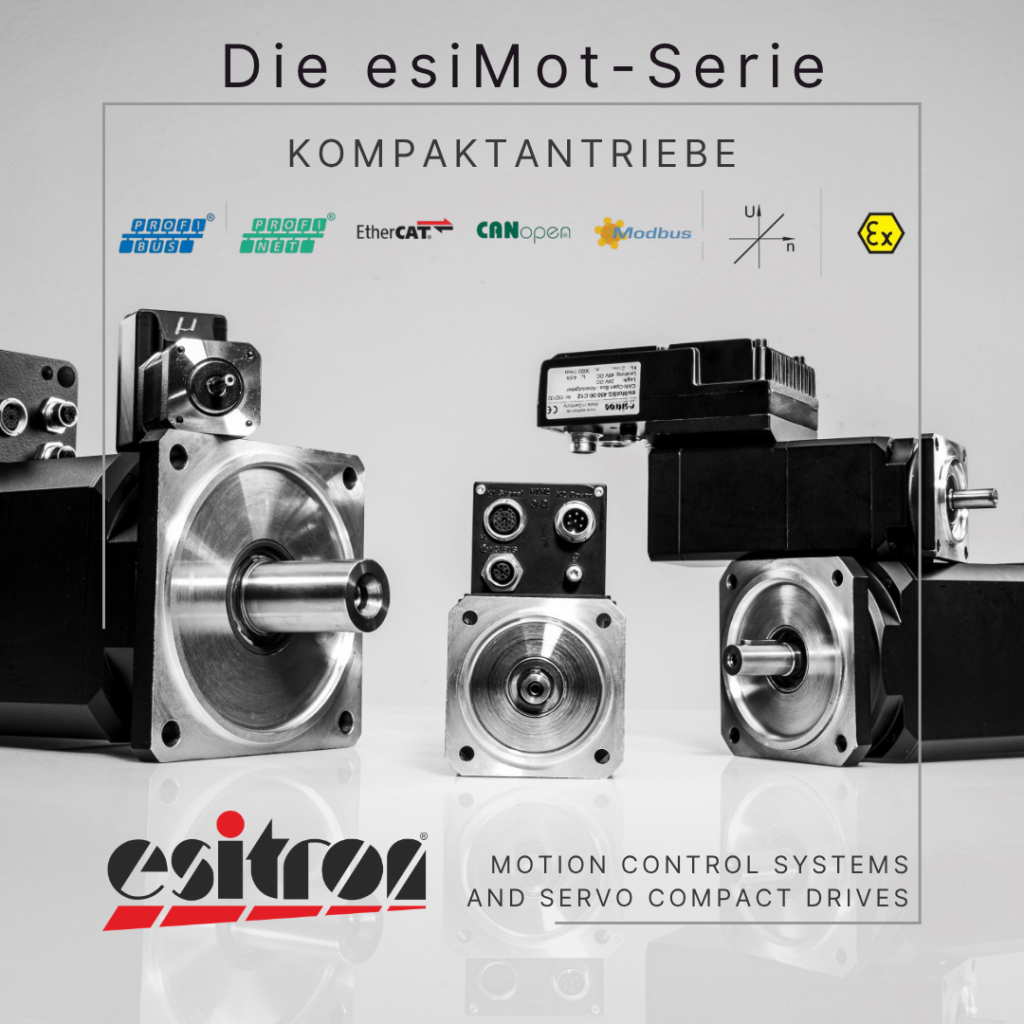
The esiMot series is available with the standard fieldbus interfaces PROFIBUS, PROFINET, EtherCAT, CANopen, and Modbus, as well as in a +/-10V version. This allows for flexible integration into existing control architectures of winding and cutting systems, tailored to the respective machine generation.
The Safe Torque Off (STO) function is available for applications with increased safety requirements. For use in areas with special safety requirements, the esiMot series is also available with explosion-proof protection.
For whom is more precise axis control during winding and cutting beneficial?
This is particularly relevant for mechanical engineers and plant designers in the packaging industry who need to combine winding and cutting processes in a single system. For engineers and developers, the shorter control loop provides more flexibility in fine-tuning synchronization, especially at higher web speeds. For decision-makers, what ultimately matters is the reduction in scrap due to precise cut edges and consistent winding quality.Besonders relevant ist das für Maschinenbauer und Anlagenplaner in der Verpackungstechnik, die Wickel- und Schneidprozesse in einer Anlage kombinieren müssen. Für Ingenieure und Entwickler ergibt sich durch die kürzere Regelstrecke mehr Spielraum bei der Feinabstimmung der Synchronisation, gerade bei höheren Bahngeschwindigkeiten. Für Entscheider zählt am Ende der reduzierte Ausschuss durch präzise Schnittkanten und gleichmäßiger Wickelqualität.
Conclusion
In winding and cutting systems for film and packaging materials, the precision of the axis control directly determines product quality and scrap rates. Decentralized servomotors with integrated electronics, such as the esiMot series, shorten the control path and thereby enable tighter synchronization between the winding and cutting units.
Do you process film or packaging material and face a similar challenge? Send us a brief description of your application—we’ll let you know if and which drive from the esiMot series is suitable or can be precisely tailored to your application: sales@esitron.de or by phone at +49 7541 6000-0.
Frequently Asked Questions About the esiMot Series for Winding and Cutting Systems – FAQ
Why does drive control affect cutting accuracy for film webs?
If the winding shaft and cutting unit are not running in exact synchronization, the cut edges shift relative to the moving web. Decentralized servo motors with a shorter control loop enable tight synchronization and reduce space requirements in the control cabinet as well as the effort involved in wiring.
What distinguishes decentralized servo drives from centralized ones in this application?
With centralized drives, the control signal travels via the signal line to the control cabinet and back. With decentralized drives, such as the esiMot series, the power electronics are located directly on the motor, which minimizes control cabinet space requirements and cabling.
Is the esiMot series suitable for high line speeds?
The shorter control path of the esiMot series supports precise speed control, which is particularly important for process stability at higher line speeds. Specific suitability for a given speed should be verified on a case-by-case basis based on the system parameters.
What safety functions does the esiMot series offer?
The esiMot series features the Safe Torque Off (STO) safety function and is also available with explosion-proof protection for areas with special safety requirements.
Yes, the esiMot series is also available with explosion-proof protection for use in areas with special safety requirements.
For which types of machines are integrated servo drives particularly well-suited?
Integrated servo drives are particularly relevant for multi-axis special-purpose machines with limited installation space, such as those used in conveyor and material-handling systems, packaging technology, or assembly automation.