esiBlog
Is the control cabinet too full?
How Decentralized Servo Drives Save on Wiring and Space
Anyone who designs a multi-axis special-purpose machine is familiar with the problem: The more axes there are, the more crowded the control cabinet becomes—not because of the controllers themselves, but because of the wiring. Decentralized servomotors with integrated electronics, such as the esiMot series from esitron, move the power electronics directly to the motor, thereby reducing wiring effort, control cabinet size, and drive installation time.
The Problem: Cabling as a Bottleneck in Multi-Axis Systems
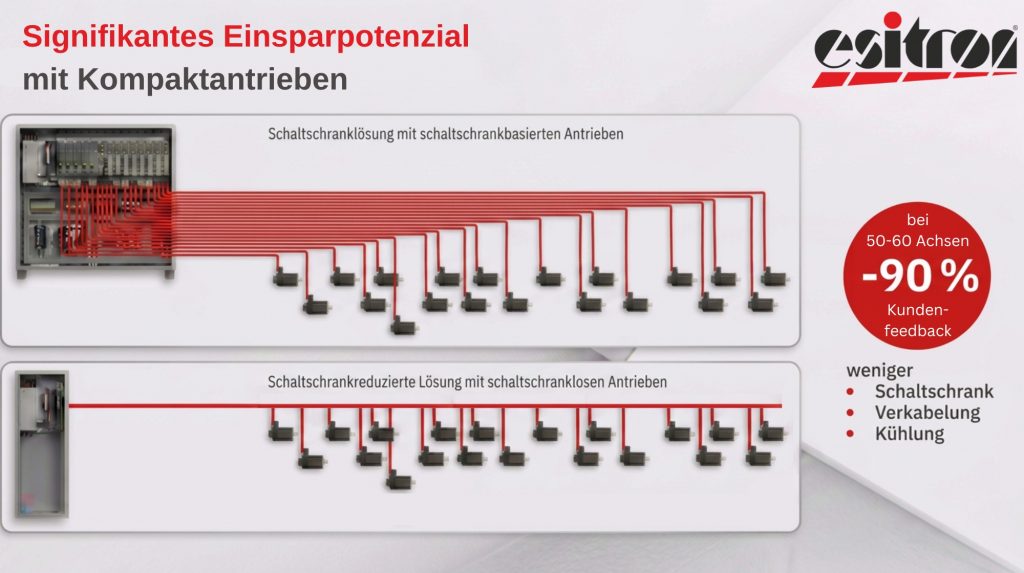
A typical example from the field of conveying and handling technology: A custom machine for transporting parts in manufacturing requires several independently controlled axes—for example, for lifting, feed, and gripper positioning. With traditional, centrally controlled servo drives, this results in a growing number of individual power and signal cables, all of which must be routed back to the control cabinet.
This has three direct consequences that every machine builder is familiar with: The control cabinet becomes larger and more expensive, wiring takes significantly more installation time, and with each additional wire, the risk of errors during assembly and commissioning increases.
The Solution: Power Electronics Directly on the Motor
In the esiMot series, the power electronics are not located in the control cabinet but directly on the motor itself. This makes each axis a largely independent unit that requires only a power supply and a communication line—instead of several individual power and signal cables per axis.
For the handling machine described above, this means specifically: Instead of running separate cable bundles to the control cabinet for each of the three axes, the cabling can be implemented using a continuous line structure. This reduces not only the amount of cable itself, but also the number of terminals, connectors, and control cabinet modules required.
What interfaces and security features are available?
The esiMot series is available with the standard fieldbus interfaces PROFIBUS, PROFINET, EtherCAT, CANopen, and Modbus, as well as in an analog version. This allows for flexible integration into existing control architectures, tailored to the specific system depending on which bus system is already in use.
For applications with increased safety requirements, the Safe Torque Off (STO) function is available, which enables the drive torque to be safely shut down without complete disconnection from the power supply. For use in areas with special safety requirements, the esiMot series is also available with explosion-proof protection.
When is it worth switching to decentralized servo drives?
This approach is particularly relevant for machine builders and plant designers who need to build multi-axis special-purpose machines with limited installation space—for example, in conveyor and material-handling technology, as well as in packaging or assembly lines. For engineers and developers, the modular axis structure also provides greater flexibility when expanding or adapting existing systems. And for decision-makers, one thing ultimately matters most: shorter installation time and lower control cabinet costs for systems of comparable or greater complexity.
Conclusion
Wiring costs are often an underestimated cost driver in multi-axis special-purpose machines. Decentralized servomotors with integrated electronics, such as the esiMot series, shift the complexity from the control cabinet to the axis itself—with measurable benefits in terms of space requirements, installation time, and system flexibility.
Are you planning a multi-axis machine and facing a similar challenge? Send us a brief description of your application—we’ll let you know if and which drive from the esiMot series is suitable or can be customized to fit your specific application: sales@esitron.de or by phone at +49 7541 6000-0.

FAQ about the esiMot series
What distinguishes decentralized servo motors from traditional servo drives with a central controller?
In traditional servo drives, the power electronics are located in the control cabinet, and each axis requires its own power and signal lines to connect to it. In decentralized servo motors, such as the esiMot series, the power electronics are located directly on the motor, so that only one power and communication line per axis is required.
Which fieldbus systems is the esiMot series compatible with?
The esiMot series supports PROFIBUS, PROFINET, EtherCAT, CANopen, and Modbus, as well as the traditional +/-10V control signal.
Is the esiMot series also suitable for safety-critical applications?
Yes, the esiMot series is available with the Safe Torque Off (STO) safety function, which enables the drive torque to be safely shut down without completely disconnecting the system from the power supply.
Is there an explosion-proof version?
Yes, the esiMot series is also available in an explosion-proof version for use in areas with special safety requirements.
For which types of machines are decentralized servo drives particularly well-suited?
Decentralized servo drives are particularly relevant for multi-axis special-purpose machines with limited installation space, such as those used in conveyor and material-handling systems, packaging technology, or assembly automation.